


Remembering V.E Day In The Black Country
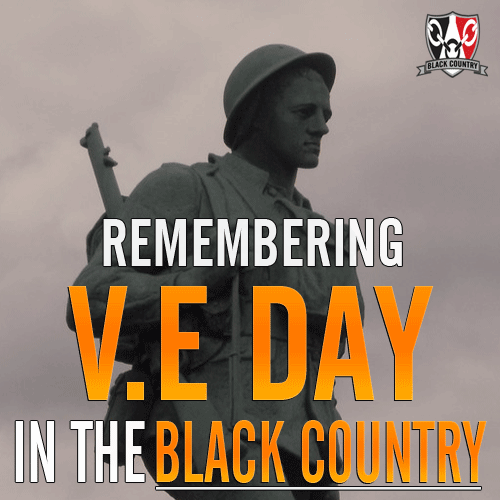
Today, we celebrate VE day and it’s 75TH anniversary. At the time of writing we as a world have not been under such strange, such awful and such tragic conditions since the second World War.
The only difference we have now compared to then is that we are, as a human race are trying to fight together to stop this virus.
We forget that all those years ago the world was at war again, super power countries fighting the evil of the Nazi’s, the Japanese empire and Musolini’s Italy. Millions of men lives taken away too early, on all sides, all in the name of WAR. Fathers and sons not coming home. Loved ones forever changed from what they saw, for what they had to do.
The Midlands, just like most places across Britain, had its fair share of battering from the enemy. From Wolverhampton to Stourbridge, from Walsall to West Brom. Those that stayed helped with the home guard, worked in the factories and if they were lucky enough built veg patches in back gardens.
Brierley Hill resident Ray Jones speaks of their childhood during this time.
“We were issued with gas masks, flimsy affairs of black rubber with celluloid eyepieces, and filters which hung down in front like amputated elephants’ trunks. They had cloth straps which had to be adjusted so that they fitted tightly to our heads. We were made to put them on at school for half an hour or so at a time so that when the gas attacks came we would be used to wearing them.
We breathed in through the filters and our breath went out through the sides of the masks, making the rubber flap against our cheeks and giving out a cacophony of farting noises all round the classroom. We would be giggling inside the masks and our hot breath would condense, fogging up the eyepieces, so that we were unable to see one another. It came as a great relief when we were told to take off the masks which, by this time, were wet with perspiration and smelling of warm rubber.
We carried our gas masks everywhere with us: to school, to the shops, to the pictures. Some of us carried them around in the cardboard boxes in which they were issued, dangling from our necks by pieces of string. Some put the boxes in cases of American cloth with carrying straps, and some threw away the cardboard boxes and carried their masks in cylindrical tins. One boy, I remember, used his tin as a weapon, swinging it round on its string and bashing anyone who got in his way.”
No-one was unaffected by the war. Children having to deal with gas masks, it does mirror our time right now. At least our children can now play games and continue to do schoolwork in the safe haven of home.
As the war continued, one Wolverhampton resident reflects his time working in aviation. Here Geoff Lloyd explains to us the “Battle of the Beams”
“On Sunday 10th November 1940 Professor Jones received a decoded message from a German Enigma signal being sent to a radio beam transmitter in France. It told the enemy stations to prepare for operations against three targets in England, numbers 51, 52 & 53 and it gave the beam settings for the three target towns.
It didn’t take Professor Jones to discover that number 51 was Wolverhampton, 52 was Birmingham and number 53 was Coventry.
The following day another message was received which contained orders for what was evidently to be very major operations under the code name “Moonlight Sonata”. However, no details were given regarding when and where.
No bombing raids were made on 11th/12th/13th November 1940, so everyone braced themselves for the following night 14th/15th.
If the raids were to be in number order, Wolverhampton could be the first target, but this could not be certain.
One word in German was mentioned in the deciphered message, “korn”, this is German for corn and it was wondered if this was a code-name for Coventry and that might be the first target, but again, this was just a guess.
The following night a massive “Moonlight Sonata” raid was made on Coventry. Heavy bombs and incendiaries were dropped causing huge fires and massive destruction. 554 civilians were killed and 865 seriously injured in just a few hours.
After Coventry, the Germans mounted a similar attack on Birmingham under the code-name of “Regeschirm”. This is the German for umbrella, which was associated with Neville Chamberlain, who himself was associated with Birmingham.
The first target, number was 53, was Coventry, and the second target was Birmingham. It left only one remaining target – Wolverhampton.
At least we could be ready for that one.
Professor Jones urgently telephoned Anti-Aircraft Command and requested them to move all available guns to Wolverhampton. This was swiftly done, and dozens of gun emplacements were formed in a circle around the town and surrounding area.
One gun emplacement was at the end of Five Fields Road, off Broadlane South, Wednesfield. This was about 400 yards from 176 Colman Avenue where I was living at the time. When enemy aircraft were overhead and the guns were firing, all the windows in the houses rattled and you could hear the shrapnel from the ack-ack guns falling back onto the roofs of the houses.
On the morning that Professor Jones had requested movement of the anti-aircraft guns to Wolverhampton, he made a point of going to see Air Marshall Sir Philip Joubert, to explain to him why he thought Wolverhampton was the next target for a massive air raid.
The Air Marshall reacted suitably, and the result was that our defences were braced as never before, for a raid on a particular target.
And then — nothing happened!
It appeared that Professor Jones had alarmed and upset the defences of the whole country on a false deduction and he was heavily criticised for it.
However, shortly afterwards he had an enthusiastic telephone call from Squadron Leader Felkin, who said that a conversation between two German prisoners had been overheard. They said that the raid on Coventry had been very successful and so had the raid on Birmingham.”
Wolverhampton was lucky that night, but the enemy continued its onslaught on the nation. The Black country people, like most throughout Britain fought hard on the fields or in the air, but also back home in the factories. George Fellows knows only too well the dangers of working during the raids of the Germans.
“During a dark December night in 1942 and whilst on duty for the home guard manning an ack-ack ant-aircraft gun outside a factory called the Patent Shaft in Wednesbury (they made tank parts for the war effort).
A German bomber raid took place. The target was obviously the factory and bombs reigned down – and we fired on approx 10 aircraft. All but one of the bombs dropped missed the target, the bomb which hit, narrowly missed the tank track assembly line.
One of the bombers was hit with flak, fired by a unit some 2 miles away from our position.
The bomber started to decend and eventually crashed in a field not far from Tipton.”
War splits families in more ways than one, separated by miles to keep children safe, or men to protect human rights. Some go half way round the world to never be seen again, but there were some good moments, good times from all.
One person explains there family and how they came to be part of the Black Country.
“Mom was eight years old when WWII began. She was the youngest of twelve children, with eight surviving childhood, and lived in the East End of London, within sound of the Bow Bells. Her father, was a stevedore on the East India Docks. With the ferocity of the London Blitz, my grandmother and her children were evacuated to the West Midlands, notably in the heart of the Black Country in a place named Cradley Heath. I recall my mom telling me of her first experiences, of having to bunk down in a big old house called Haden Hall in the middle of a park. The place has always been a bit spooky, and she didn’t like it there at all.
The family were then found accommodation in a large house in King Street, Cradley Heath. She found it all very strange, and was an odd one out at school with her strong cockney accent. However, she went on to make friends, and her best friend was named Lillian.
My grandfather had stayed in the East End, as he was a worker on the docks. Sadly he died during the war, but I do not know if this was as a result of the bombing of the docks. His body was brought to the West Midlands and buried in a local cemetary.
At the end of the war my grandmother’s older children decided to go back to London, but my grandmother stayed here, and as my mom was now fourteen years old, she stayed here too.
As mom and her best friend grew older they started to notice the boys! The girls went to a church youth club and started to be noticed by two particular local boys. They became their steady boyfriends, and after time eventually became their husbands.
If it had not been for the London Blitz my mom would have stayed in the East End, would never have met my dad who was a Black Country boy from Cradley Heath, and me and my sister would never have existed. So, for me at least, some good did come out of the horrific experiences of the Blitz!”
By 1945 the war had come to an end in Europe and we celebrated VE Day. Its hard to imagine what it must have felt like, 6 years of hardship, 6 years of sleepless night, 6 years of war finally over and the healing and the rebuilding could begin.
Around the country parties in streets began, from Inverness to Portsmouth. Here Janet from Wolverhampton tells us what it was like to be there at that time.
“What I remember about VE Day is that it came over very strongly that the war was over. We got the big red, white and blue flags out and draped them around us. Even the men had them draped around them. We all had instruments. Our family had a big hand-bell and some had horns and bugles. The whole crescent came alive. We took it in turns to run up and down ringing the big bell. Our families were very patriotic.
Somebody started to walk into Wolverhampton town and we all followed them. I got separated from my family on the 2 mile walk but it didn’t matter. We were all together from the crescent and we all went to town. We’d not been able to gather together like this before in the war because of the blackout. We seemed to be there for hours and hours and we were all so excited. It was the party of a lifetime — everyone was kissing and shaking hands. What a party!
It was dark but all the lights were on — no blackout. Another world opened up to us that day – it was like no other.”
And it was like no other. The world has changed over 75 years, the world has still had its conflicts, its wars, its battles, its genocide, its famines, its pandemics, BUT its also had its peacemakers, its inventors, its humanitarians. Its charities, its scientists and its doctors and nurses and its love.
75 years on and we have learnt a lot and now, in this pandemic, we all still have a lot to learn. We hope you all remember those who sacrificed so we all have a better world to live.
Let us not forget.
Thanks to the BBC WW2 Peoples War articles for references.